

 As a mom who juggles board meetings and bedtime stories, policy memos and playground runs — like so many working parents — I’ve struggled to balance career and caregiving. And I know how precarious that balance can be without reliable child care.
At the Burke Foundation, we’ve spent years supporting the health of families in their children’s earliest years — piloting and scaling such innovations as Family Connects NJ, HealthySteps, and Centering, reaching thousands of New Jersey families. Our grantees’ accomplishments confirm what decades of research already tell us: Invest early, and the returns — for children, parents, and society — are extraordinary.
Now, we’re turning our attention to the next frontier: child care.
Why this, and why now? Because affordable, high-quality child care is the thread that ties everything together. It enables parents to work and pursue education. It supports businesses suffering from labor shortages. And it builds the foundation for children’s healthy development and school readiness. Without it, all our other investments — in health, education, and family well-being — are harder to sustain.
As labor economist Kathryn Anne Edwards notes in our conversation below, “From the economy’s perspective, this is a market that isn’t doing its job, and the longer that persists, the worse our economy will be for it.”
In this issue, we explore the need to treat child care as critical infrastructure — and how New Jersey and states across the country are reimagining child care to meet this moment.
Atiya Weiss
Executive Director, the Burke Foundation
1 big thing: Child care is a public good

Why it matters: Families that can’t find or afford quality care face difficult tradeoffs: reduce work hours, turn down promotions, or leave the workforce altogether. That’s not just a personal loss — it’s a drag on our entire economy.
📊 By the Numbers
$122 billion/year — Estimated cost to the U.S. economy from inadequate child care, in lost earnings, productivity, and tax revenue, according to the Ready Nation.
$3.6 billion/year — Annual cost to New Jersey’s economy due to child care shortages, based on analysis from the same study.
48% — Share of non-working New Jersey women saying they’d return to work if they could get affordable child care.
Up to $13 — Estimated return on every dollar invested in early care and education, according to research by Nobel laureate economist James Heckman.
The bottom line: Child care isn’t a “nice-to-have” social service. It’s core economic infrastructure. It’s how we strengthen the workforce, grow GDP, close gender gaps, and build an economy that works for families and businesses alike.
2. New Jersey in motion

Talk in New Jersey about child care is in the midst of an encouraging shift from if to how soon. What was a niche policy issue is now front and center in gubernatorial debates, boardroom discussions, and community conversations.
What’s happening: Recognizing child care’s value in attracting and retaining talent, many employers — big and small — are calling for child care to be a higher priority.
Out of this growing momentum came the Start Strong NJ campaign, launched last month to share the message that affordable, high-quality child care must be a reality for every New Jersey family.
The campaign unites advocates, parents, providers, and business leaders to advance common-sense policy solutions — expanding subsidies, strengthening the workforce, and modernizing an outmoded system to keep providers open and families supported. It’s showing that child care is essential infrastructure — not a problem for individual families to bear, but a shared public priority that requires a societal solution.
Candidates agree: At the campaign’s launch event, Republican gubernatorial candidate Jack Ciattarelli and Democratic lieutenant governor candidate Dale Caldwell agreed affordable child care must be a statewide priority. Their participation signaled a rare bipartisan consensus on an issue that transcends politics and touches every New Jersey family and business.
📺 Watch Start Strong NJ’s compelling campaign video →
What’s next: Start Strong NJ is developing a Child Care Blueprint for the next governor — a plan for making child care available to all families and making sure child care educators are compensated at a level reflecting these hardworking people’s value to New Jersey.
3. The economics of care: A conversation with Kathryn Anne Edwards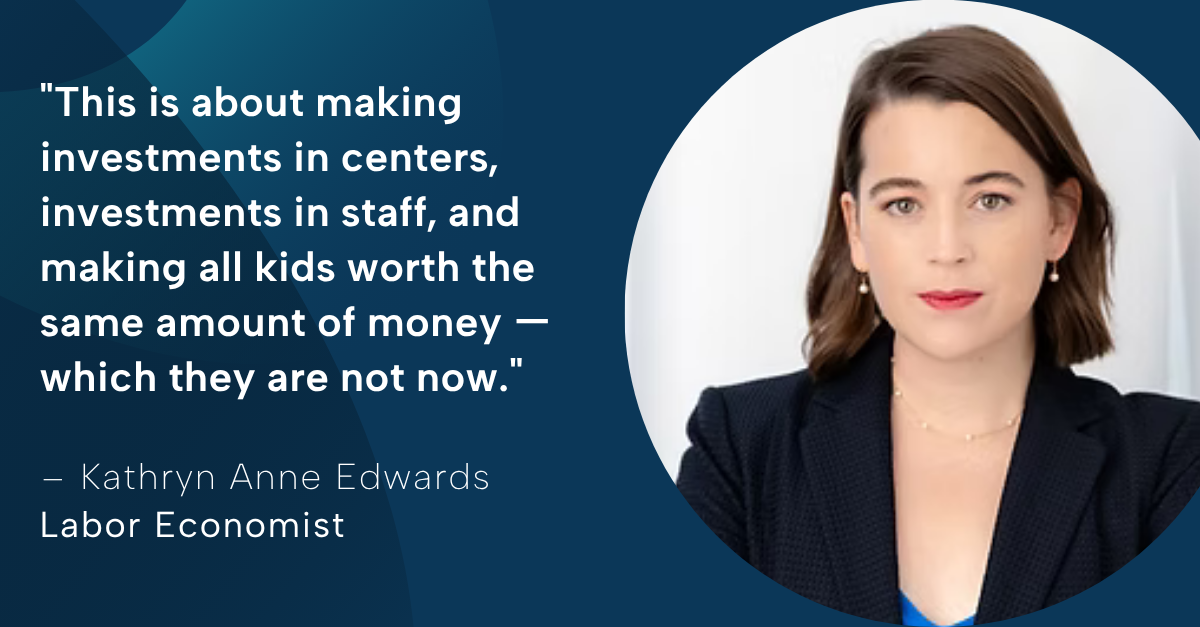
In a New York Times essay, Kathryn Anne Edwards writes:
“Child care is infrastructure — as vital to the economy as roads or broadband. Without it, families can’t work, businesses can’t grow, and the economy can’t reach its potential.”
A labor economist whose work explores how family policies — from paid leave to child care — shape labor markets, social mobility, and long-term economic growth, Edwards advises on workforce and economic policy and writes regularly for The New York Times, The Atlantic, and other national outlets. Her work brings rigorous analysis to a simple truth: Investing in care is investing in economic strength.
We spoke with her about what policymakers often get wrong — and how common-sense reforms would strengthen families and the economy.
What do people often misunderstand about child care as an economic infrastructure issue rather than a social or personal issue?
Most people, either explicitly or implicitly, assume the government’s position on child care is an endorsement of a type of motherhood. If the government pays for child care, it’s because they’re saying that working moms are better. If the government doesn’t pay for child care, it’s because women are supposed to stay home. Both are wrong and they distract from what is a practical issue in our economy — that the private provision of child care is a market failure.
This isn’t analogous to being unable to afford Maine lobster or a house on the shore. That some people can’t afford child care causes real problems in our economy. From the economy’s perspective, this is a market that isn’t doing its job, and the longer that persists, the worse our economy will be for it.
What other policies would help women stay in and advance in the workforce?
Child care is only one piece of the puzzle. Something that gets really discounted and underappreciated is the right to flexible work arrangements and part-time work. The U.S. doesn’t have a high-paid part-time labor market. Most of other industrialized countries do. They’ve written it into labor law. So women who have young kids at home negotiate that they keep their nice job — the job they went to school for, that pays well, where they’re on their career track — but they don’t work full-time.
Even if they have child care, most families don’t have coverage for an 8:00 a.m. to 6:00 p.m. workday. They don’t have days off that correspond with vacation days at child care centers or schools. And they don’t have after-school care. And what about people who work overnight shifts at hospitals or in hotels, or work 7:00 a.m. to 7:00 p.m. because they’re at a police department? None of these people have easy access to child care.
Flexible arrangements would serve so many others as well — people who require a lot of medical visits for their own health conditions, or who are caring for a sick parent, partner, or child — they all could benefit.
What would good family policy look like?
People have strong preferences and beliefs over what’s the best type of care. But a cold-hearted economist would point out that whatever the care arrangement, rich moms will find the best version of it.
It’s very disempowering to say, “Sorry, your income is what is best for your kid because this is a private market.” But if care is being sold, who will have the best care? Rich people. What the government needs to do when it sets out a child care policy is neutralize the income effect so every center is catering to children and not to parents’ income. This is about making investments in centers, investments in staff, and making all kids worth the same amount of money — which they are not now.
What final point do you want to drive home to policymakers and the public about child care?
Universal child care helps families invest in children in a way that they’d like. That’s a win — particularly as there’s so much inequality in childhood poverty that the government can’t fix. The government doesn’t get to send everybody to Disneyland. But child care is an investment the government could easily make. It won’t fix everything, but we know it’ll help a lot.
We get so caught up in “what is the role of the government?” and “what is the right type of motherhood?” when those are all distracting conversations. The result is that we hold ourselves back in the economy, in family well-being, and in investment in children — instead of committing to one important thing we can do.
4. Across the nation, big moves 💪

Across the political spectrum, states are proving that child care reform is possible and enjoys wide public support. Some examples:
New Mexico provides universal access: New Mexico this year became the first state to guarantee free child care to nearly every family, funded through a voter-approved state constitutional amendment. “By investing in universal child care, we are giving families financial relief, supporting our economy, and ensuring that every child has the opportunity to grow and thrive,” says Gov. Michelle Lujan Grisham.
Vermont boosts funding: Vermont made headlines by funding child care through a new payroll tax. The law, Act 76, invests about $125 million annually to make care more affordable, expand eligibility to families earning up to 575% of the federal poverty level (about $180,000 for a family of 4), and raise pay for early educators.
Connecticut invests in workforce: Tackling one of the biggest challenges in early childhood care, Connecticut enacted legislation establishing the country’s first statewide pay parity system for early educators, aligning their salaries with K–12 teachers. The law also expands professional development supports and career pipelines to strengthen and stabilize the workforce — and will eventually make child care free for families earning up to $100,000 a year. Gov. Ned Lamont called it “a major part of what will create a stronger, safer, and resilient state.”
Montana expands affordability: New laws make care more affordable and stable for families and providers. The state capped family payments at 9% of income and ended policies that reduced payments to providers when children missed days. Lawmakers also explored new tax credits to help families cover child care costs and encourage businesses to offer on-site or subsidized care.
Utah keeping providers open: The state extended child care stabilization grants to help centers stay open, covering key operating costs like rent and utilities as federal relief dollars wind down. State leaders are also studying ways to expand funding, support child care workers, and reduce barriers for new providers.
The takeaway: Through a variety of policies and funding methods, red and blue states are agreeing that child care is valuable public infrastructure. Those acting boldly today are setting the stage for stronger economies and brighter futures.